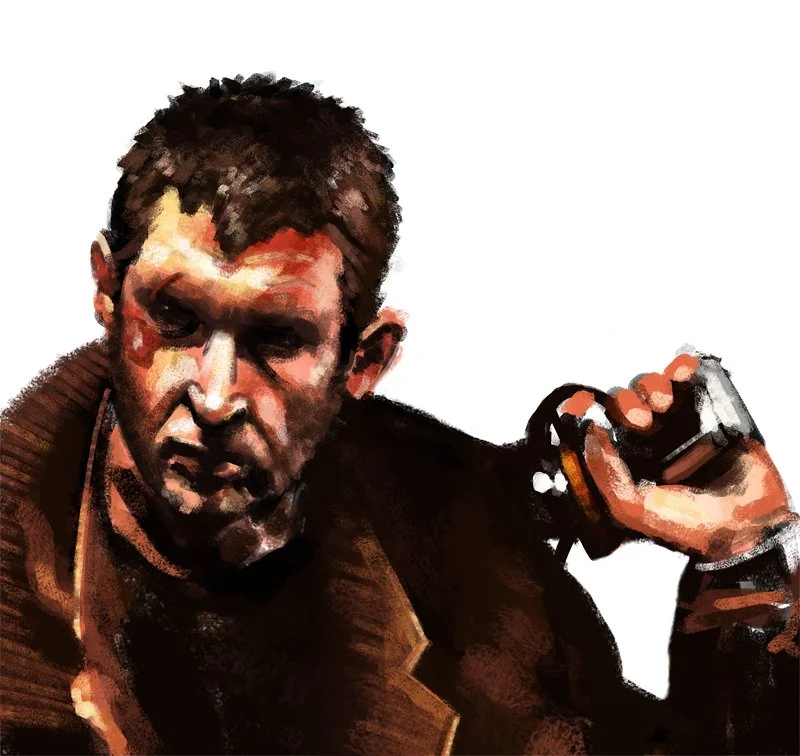
On the surface….
Rich is not the poster-boy for martial arts. He’s bearded and burly. He’s quiet. He owns the pick-up truck parked on the side of the highway in deer season. He prefers using knives and sticks for self-defense. But when you hear him speak, words like tenacity and sincerity and modesty float to mind. Rich leaves you with the sense he embraces autonomy and despises injustice. These qualities make Rich a highly regarded instructor who teaches his students to exert real force and pain against potential assailants. He says, “That’s the dirty secret of combative martial arts. … if you’re not doing it from the perspective that I’m learning to do this to defend myself in the event that I am attacked, you don’t really get any of the other benefits like health or fitness.”
In high school, Rich sat with the unpopular athletes. He wrestled. He boxed. He studied martial arts. But unlike the football players and the basketball players, his crowd didn’t experience the fleeting glow of high school celebrity. Rather, Rich focused on the long game; after school he worked out at the Boston Young Men’s Christian Union where old men, seasoned teachers, informally shared their respective knowledge with Rich teaching him traditional Japanese Jiu Jitsu, Judo and catch wrestling, providing Rich with a colorful swath of life perspectives and fighting skills.
Rich was still a senior in high school when his passion for fighting took an unexpected turn: he joined the International Blade Fighter’s Guild. After meeting the guild’s founder Tom Sotis, Rich spent the next two years training with him. Sotis hailed from a lifetime of kenpo, competitive kick-boxing, and kun-tao and for three nights a week, Sotis taught Rich fundamentals through a combination of Filipino, Chinese, and Indonesian martial arts. At the same time, Rich worked behind the front desk of a low traffic gym in downtown Boston, a few blocks from China Town. During his shifts, Rich practiced his forms behind the desk. During his breaks, Rich walked to Silky Way in China Town, a small storefront that hawked cheap Chinese imports. In the back, up a flight of stairs, Rich discovered a bookstore dedicated to martial arts books and videos. He bought two books a week, bringing them to the front desk, mixing the theories with what he learned in his training with Sotis.
But Rich’s routine and focus fractured when he was twenty-one years old. He fell in love. He left Boston and he moved to Hoboken, New Jersey for about a year until she broke off the relationship. He returned to Boston and picked up training with Sotis again, but quickly, Rich realized something had changed. He wanted more. He broke off his training with Sotis and he began to practice on his own.
As he trained alone, Rich’s studies branched into eastern concepts like chi,ji, and ling. Rich cringed at the western world’s co-opted use of eastern concepts; he thought these fuzzy notions sounded hokey and unbelievable. For a fighter who grew up in Boston, the concepts were hokey and unbelievable. But he says that as he read more, “I began to realize these concepts are contextual. They mean different things in different situations. But I don’t speak Chinese so I wanted to know exactly what these different things were.” Rich began to study eastern concepts through the western lens of biomechanics and physics and he realized definitions were getting lost in translation. Unfamiliar Chinese terms were not just co-opted concepts from an ancient world, but practical terms that could be applied to body mechanics. He sought to understand the middle ground of western and eastern concepts from a fighting standpoint; he wanted to connect the dots.
Over time, a picture began to emerge unifying his years of study and practice. Rich saw that across all martial arts, the same body mechanics were used. And ultimately, fighters of all traditions used the same six punches, the same elbows, the same holds, the same throws. Soon after this realization, Rich met Baste Carlos and discovered Carlos Hermanos and Kalis Ilustrisimo.
Known as ecsrima in its homeland of the Philippines, Carlos Hermanos and Kalis Ilustrisimo are a blade-based martial arts using everyday items such as sticks and knives for self-defense. And as Rich first witnessed these fighting styles, he fell in love with Carlos Hermanos’ pragmatic training methods and Ilustrisimo’s clean mechanics, effectiveness, and grace.
That was thirteen years ago.
Rich now teaches his own system of combatives and Carlos Hermanos while studying Ilustrisimo and he is the ideal teacher: his sincerity and passion translates to an unerring focus on teaching people, often one or two at time, how to win a fight against an assailant. He won’t teach his students anything he doesn’t practice himself. A sense of social responsibility guides him as he separates his teaching into two definitive categories: personal security such as awareness of your surroundings and defensive fighting techniques. He insists on differentiating between a person’s fitness and his health insisting his students find the middle path.
Despite the colorless hue of a buzzword: Rich is authentic. His sincerity as a student translates to his authenticity as a teacher. Rich demands the same sincerity from his students. “If you are doing it half-hearted and you’re not actually investing the time into it, you’re not going to get the results. You are at that point… dancing. If there is no emotional content or intent behind it, it’s better to practice right for ten minutes then going to a two-hour class and waving your arms around.” And as artist Jordan Henderson writes in reference to the blade fighting painting shown above, “There is no substitute for good ol’ fashioned practice. Do something every single day, even if it’s very small – keep moving in the right direction.”